
Weconomics Data Commons
A data common, or data commons, is a shared, community-governed repository of data and associated resources, often cloud-based, designed to facilitate data access, analysis, and collaboration. It acts as a centralized platform where individuals and organizations can contribute, access, and utilize data for various purposes, including research, claim verification, information production, decision-making, and innovation. A data commons framework is a framework with a governance structure that allows a community to manage, analyze and organize access to a shared, secured an reliable reality. A data utility is public/private, often cloud-based, software platform, governed by a democracy.
Similar to other utilities
A data common/utility is a shared entity and consists of at least an ontology, a taxonomy, specific semantics, takes regulations into account, has a transparent governance structure and has a certain degree of standardization. You can compare it to organizing clean tap water. We have a single grid for water production and distribution (the commonality). What you then do with tap water is the application. You can use it for drinking, cooking, showering, or watering plants. A data common can be organized by the government, by companies, private/public organizations, or by citizens themselves, and of course, by a combination of these. Private/public collaboration is preferred, just like other utilities. A good example of an information commonality is Wikipedia. Anyone can contribute to Wikipedia, provided they adhere to a number of rules and guidelines. Wikipedia is a commonality with different rules and guidelines than your own wiki on your intranet.
Why
The Accenture Technology Vision report 2018 shows that around 30% of the costs of companies is spend on checking other databases to get an answer to a question. The Weconomics Data Common is the basis of a digital assembly line and enables organizations to become more productive, ensure privacy and balance the power between humans and their tools (such as companies and governments). With a data common, organizations can work smarter together without the burden of organization silos and walls, partnership frictions, GDPR, vendor lock-in and markets with high transaction costs. The most important principle for the Weconomics Data Common is: data entry and maintenance in one place and provide access (via a token) to this data. So not organizing data ownership is important but organizing access to data is the basis of the blockchain-based digital assembly line.
What?
If we want to improve productivity, want to guarantee privacy and balance power we’ll need to organize supply and demand of data with new principles. A human connected to a tool (for example an employee with a laptop), is already organizing capability and therefore an organization. Organizations that work smart together can connect and disconnect with other organizations. Humans and tool work smart together in communities when they are connected to a shared information and transaction network that is connected to a general data utility. Weconomics Data Common is based on the ‘profile -> connect -> collaborate’ principle. A data common uses principles such as openness, sharing, crowd sourcing, crowdfunding, and direct communication without agents.
The basic principle of a shared information and transaction network is thinking without organization walls and non transparent markets. Customers have their own portal, to search and transact products and services, while suppliers only need to maintain data in one place. It is no longer about data ownership but data accessibility. Employees have their own portal to select courses and patients control their own medical records. Through the network, transactions can be processed from supply to demand and all community partners can use the same transaction network where applications or apps transform (transaction) data into information.
 How?
How?
Weconomics Technologies builds a ‘new’ internet with reliable, meaningful and secured data. Information is produced and shared through a data connector and ‘data socket’, connected to a general data utility. A kind of power grid for basic attributes such as date of birth, social security number and address. When transaction data is kept in a shared ledger (e.g., a blockchain) trust can be organized with almost no friction.
A general data utility contains data that are used by multiple domains and needs to be maintained logically seen in one place. Access to basic data, is provided via a data token and socket (if you have the appropriate privileges). This process is as simple as access to electricity. Through an application (for example a portal), data can be easily converted into information, like a television converts power into images, an electric piano converts power into all kinds of sounds and a blender converts power into movements. It would be weird if we all would have. different power sockets for television, keyboard and blender in our homes.
We focus on the development of a data common (core, basis and framework = infrastructure and scalable) in relation to the context (domain, industry = application and flexible). We try to do this with a minimum of agents between supply and demand.
We can set up a simulation, demo, Proof of Concept and Minimum Viable Product.
We make a use case, for instance with 4 course suppliers and 4 course customers work together to profile, select, purchase and pay for a service in their (mini) community. But if it works for 8 organizations, it will also work for 800.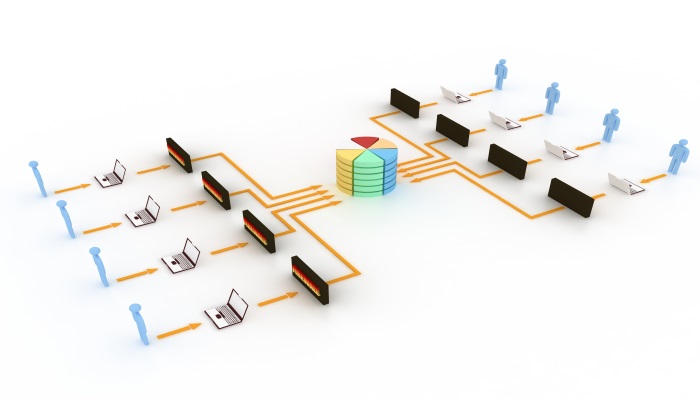 A data-driven ecosystem is characterized by a n:n relationship. This means: many consumers and many producers work together. The network is often executed by a network supplier who is the hub or support center for the community that works with distributed ledger technology and or has an own blockchain.
We expect that the most project for the next years will be use cases, learning-, simulation and Proof Of Concept (POC) projects. At this moment we are working together with our stakeholders on several ideas, use cases and projects in different industries.
Maybe you think: why different industries? Why not focus on one or two? But don’t forget these industries, this ordering is a legacy of the industrial revolution. Data, blockchain, AI and the digital assembly line don’t ‘see’ these industries, don’t see borders. These are human contexts, not digital. Digital only ‘see’ zero’s and ones’, ‘bits and bytes’. We work agnostic for data-intensive organizations independent from industries , because we think and work in a metaverse (a binary representation of the human world).
More information
If you are interested in our services, please contact us.
tags: data_common
 Weconomics Technologies