
Our approach
Most organizations experience the environment as volatile, uncertain, complex, ambiguous, and paradoxical (VUCAP). They see radical changes, but changes are only radical if you start too late.
Weconomics Technologies offers the most comprehensive solutions to help you become compliant and future-proof, with a focus on perspective change, system leadership, relevant technology, transition, and community engagement.
Why Weconomics? Perhaps you want to reduce costs, shorten information lead times, or enhance quality? Maybe you would like to contribute to solving social problems? Or would you like to establish a data-driven value chain that works effectively with generative AI and accurately reports on CSRD properly? Or perhaps you are interested in a straightforward solution for complex organizational problems? We developed a specific approach and use a technology that is more than ten thousand years old. Curious which one? You will receive answers during our free monthly introduction webinar.
We help organizations in 4 steps:
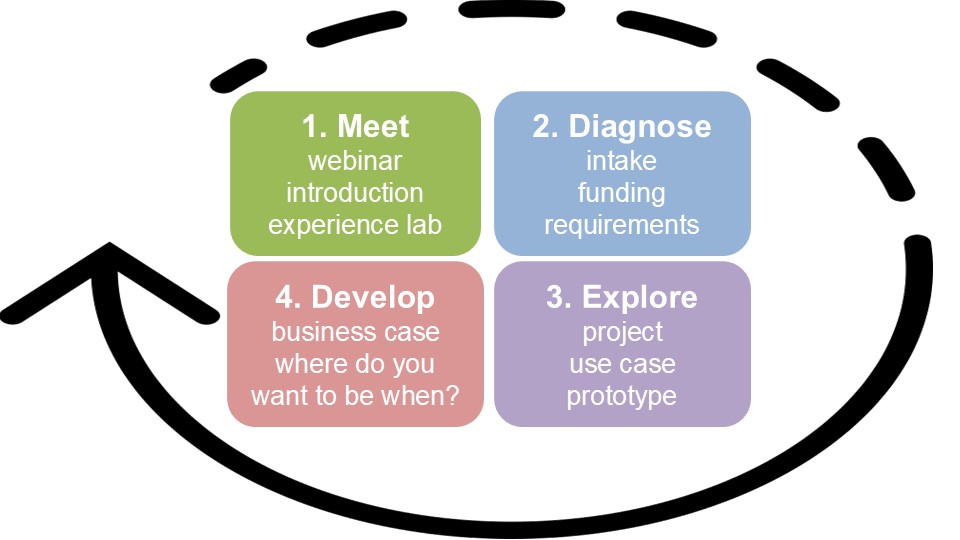
Furthermore, our approach consists of a number of (self-developed) concepts:
Data-driven organizing
Before you define data-driven organizing, you first need to determine what data is: an abstraction or representation of our human/economic world in symbols. More then ten thousand years ago this started with cave drawings, now we have binary representation: zero’s and ones (think of digital twins).
After defining what data are, you can define what data-driven organizing is: establishing facts (humans, means, transactions, events), finding consensus on this, then storing the data in such a way that you cannot adjust it unilaterally and afterwards, then making data accessible in a targeted manner (not sharing and certainly not owning data in your own company IT-system) and finally enriching this data. Period.
For 50 years, we’ve had a protocol that ensures messages travel from sender to recipient in practically the same way. The internet protocol moves packets of zeros and ones from A to B in the same way. The computer and telephone line aren’t interested in the content of your message. The technology is, as it were, deaf and blind.
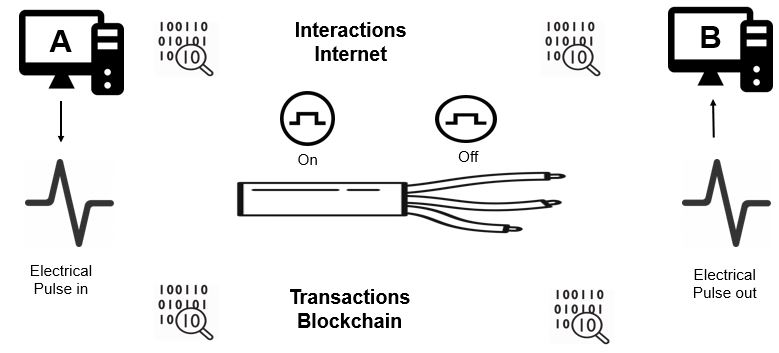
With blockchain technology, we can now apply the same principle to sending an asset, product, or service from seller to buyer. The protocol isn’t interested in the value that goes from A to B. A blockchain is also deaf and blind. The only requirement is to represent values from our economic transactions with tokens.
One of the new organization concepts to accomplish this is called: the digital assembly line. With data-driven organizing and the digital assembly line, you do not take a company but assets and transactions in an ecosystem as a starting point. You determine facts together, preferably with calibrated and validated sensors or multiple independent senses. You then want to store facts about which there is consensus in a way that they can no longer be adjusted unilaterally and afterward. You can use blockchain technology to create a shared, secured, and accessible accounting system, not per company but per asset in an ecosystem. You then organize access to data in a way that suits the needs of market parties and is necessary for the regulations. And finally, you can enrich this data with (generative) AI. With data-driven organizing, significant office costs can be saved, lead times will be shorter, the quality of service will increase, products will have a longer shelf life, and there will be fewer emissions. For more information on data-driven organizing, read the whitepaper: Data-driven ESG, CSRD, smart contracts and AI.
We work industry-agnostic
One of the main reasons why it is very difficult for organizations to utilize generative AI or become more productive is that they adhere to outdated organizational dogma: they view their own company as the center of the universe. They organize supply and demand of data with the same modus operandi as the production of cars, for example. You can not organize data-driven with factory DNA. You cannot train and use generative AI with only your local IT systems and datasets. Many organizations benefit from unnecessarily complex processes at the application level because they earn more. At the data level, it’s essentially the same: data attributes are created, read, updated, or deleted (CRUD). For interactions and transactions, packets of zeros and ones are sent from A to B. From a data perspective, this isn’t complicated.
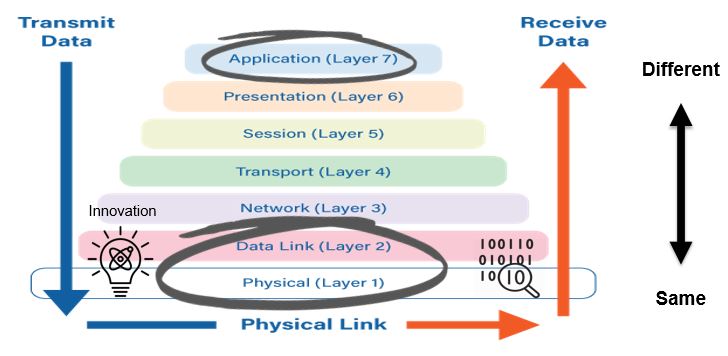
An important advantage of data is that it is industry-agnostic. A data attribute, such as your date of birth, is not interested in which industry it is used: it can be for HR purposes, governments asking for it, or to prove that you are old enough to buy alcohol. We represent our human world in bits & bytes, in zeros and ones. With a shared, secure, and accessible reality, data can flow more smoothly between previously disparate industries, and generative AI can be trained and utilized effectively. The human-created differences and representations can be organized at the application level. The transport and storage of packets of ‘zeros and ones’ can be organized in the same way on a lower level. The data infrastructure does not need to be specific. A road network, for example, is also agnostic, in this case, auto-agnostic. Within the limits of the law, it does not matter which type or color of car you drive on the road.
Real transformation
Real transformation in our vision is a transition into a durable, digital, decentral and more humane future.
That is a future without redundant work, digital waste, siloed IT systems, and central governance. The future of work means less monetized work. An effective strategy is to build new organizations on the edge and make existing ‘old school’ organizations obsolete. That is okay because, during your transformation, you discover new values and business models. As a caterpillar, you can eat a lot. As a butterfly, you value the ability to fly and reproduce yourself. To become a butterfly, the caterpillar has to ‘choose’ for a transformation and let go of the old. Fundamental transformation is not only a different technology but, above all, new DNA and a different way of thinking in which you give up some autonomy, let go of your organization as the center of doing business and work smartly together in ecosystems.
Our experience is that many organizations wonder how, with a tight talent market, increasing regulations, and customer demands, for example, they can free up the time to be fundamentally and consistently engaged in a transformation program. How paradoxical it may be, transformation is more about a gradual process than a quantum leap. The quantum leap is the result. The transition and many small steps (in the right direction) is the process. Transformation is not about turning your entire organization upside down. It is about design, discontinuity, re-engineering, starting over again, building a new organization on the edge, and transferring existing effective tasks and processes into a ‘new building.’ Transition is the road to transformation.
To understand the difference between transition and transformation, you need to see the difference between improve, change and renew. In short: Improve is to maintain, change is to widen, and renew is to construct a road:
- Improving is optimizing the current situation, for example, digitization, but still using the existing business- and operating model.
- Change is the adaptation of new processes and customer relationships (digitalization = digitization + new business model).
- Renew is to start over and break down and (re-engineering, reducing digital waste, erasing redundant work, etc.)
The future will be durable, digital, decentralized and more humane. That is a big vision. But The biggest problem with having a big vision is that getting excited about the trivial, small stuff that needs to happen on the way there is tough. However, execute those little steps well, and you’ll go places well beyond what you envisioned.

To understand the way we look at transformation, you can use the metaphor of the pioneer traveling: leave your safe haven behind, use your telescope and compass, choose a path, and bring a backpack:
- Safe harbor (here and now): spend enough time and attention to let go of routines (dominant logic, dogmas, paradigms, and pillars of the old system). You need a Copernican revolution. Christoffel Columbus on this: “You can never cross the ocean unless you have the courage to lose sight of the shore.”
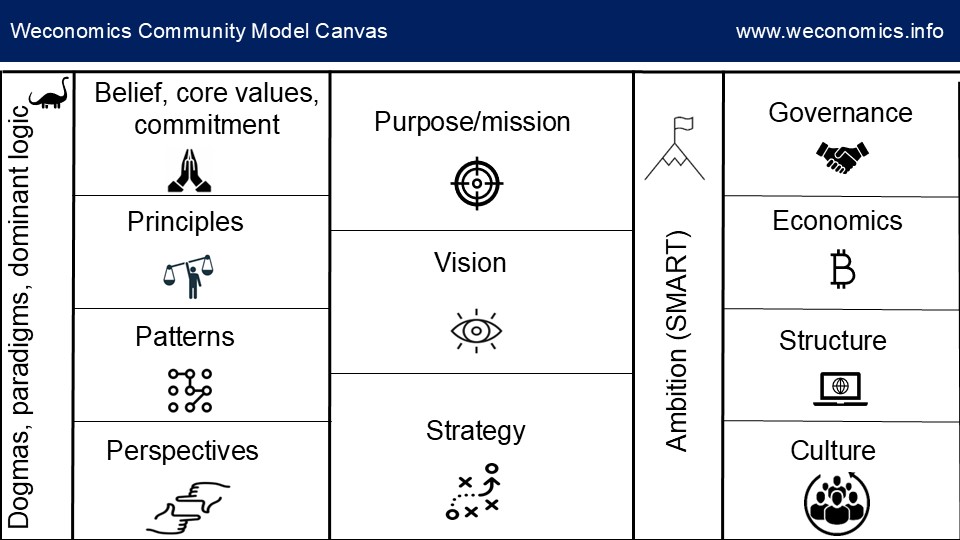
- Telescope (there and later): be aware of the context you are in (soon). Look with different perspectives and find out what you believe, what the patterns are, and which organizational principles there are
- The compass (destination, ideal situation for men & society, long term, 5-10 years): devote sufficient time and attention to awareness. Above all, think about the direction and let yourself guide by principles, patterns, different perspectives, and a moral and common sense “compass.” You should not lose this compass on the way or put it in your backpack. The direction must always remain visible to organization stakeholders in terms of purpose, vision, mission, and ambition. You may not subordinate the compass to the road (medium long) and backpack (short term). A compass is not a route planner. A compass has to do with compassion: tell your story and what you belief with a passion to others, and they will follow (eventually). Albert Einstein on this: “You can’t use an old map to explore a new world.”
- The road (budgets, capabilities, medium-long term, 1-5 years): choose a strategy; choose a road along which you want to realize your ambition based on your compass. Make sure there is sufficient support from your stakeholders. And the content of your backpack should be based and prioritized on the route you choose.
- The backpack (short term, next year): choose your instruments for structure, culture change, governance, economics, and development. Start with small manageable projects, with one or a few smaller projects contributing to the new vision and ambition. Provide new skills if necessary. During the projects, you take stakeholders along in the new thinking and doing. But remember: everything you choose and do is in the right direction!
You see this metaphor in some of our important methods: The Community Model Canvas, backcasting, solution development journey, and double-track development.
Community Model Canvas
It’s often impossible to find enough reliable data within an organization to properly train AI models. Therefore, much better collaboration within data-driven ecosystems will be necessary. The community model canvas helps to develop connections for your data-driven ecosystems to design, develop, train and use generative AI connect to the digital assembly line:
Idealized design & backcasting
Start with an Idealized Design, with the end insight, go back to today and develop step by step in the right direction: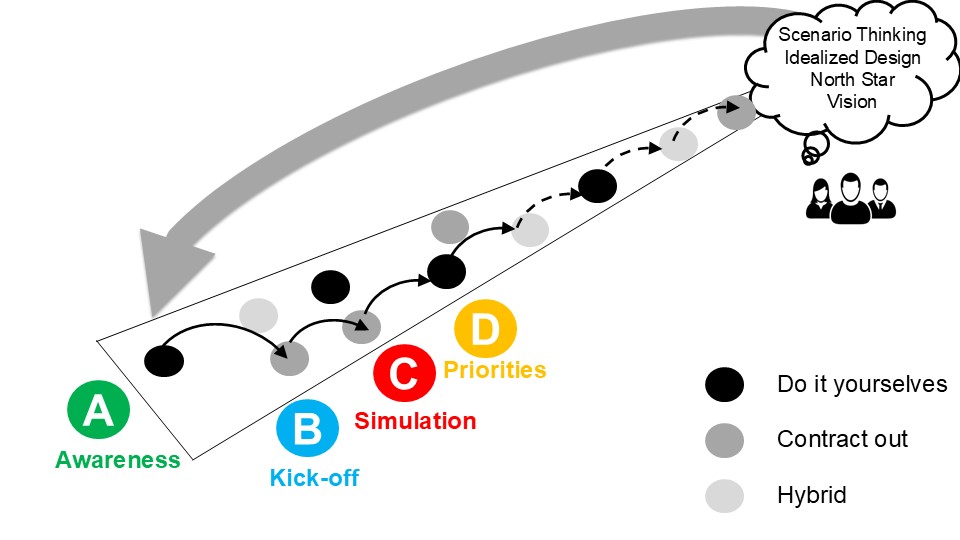 Solution development journey
Don’t start with a business case but with a learning case (project description). We follow the next steps by using (data)technology to solve social problems and offer benefits for organizations in the short (compliant) and long term (future-proof):

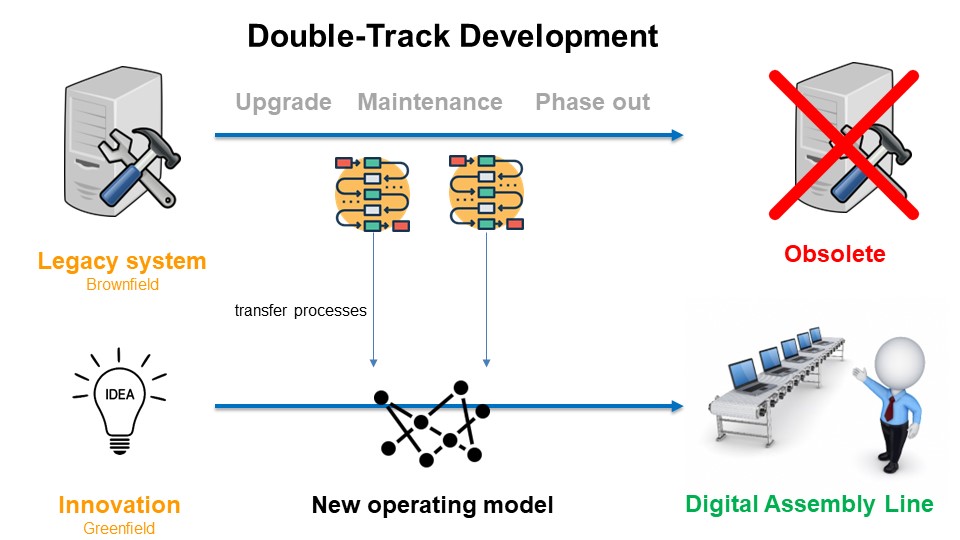
Double-track strategy
It is impossible to transform from the existing situation into a decentralized autonomous organization in one go. The solution for this is a double-track: strategy on the one hand, you choose to upgrade, maintain and phase out legacy systems in the short term and make processes suitable for transitioning to a new operating model, ecosystem, and an digital assembly line. On the other hand, you are already starting to innovate greenfield for the long term. It is essential that you consciously phase out existing systems.
Manifesto for system leadership
We believe that leadership is not just about managing people and resources or using the latest technology, but also about creating a vision and leading the way towards a better future. As we navigate the complications of the modern world, we must embrace a new style of leadership. We believe that system leadership enables us to:
- Let go of dogmas and dominant logic: we are confronted with turbulent times. However, the turbulence is not the problem; rather, it is the fact that we solve problems with outdated and flawed thinking.
- Be agile and adaptable: we must be able to adapt to changing circumstances and embrace new opportunities. We must be nimble in our thinking, constantly seeking new perspectives and ideas.
- Think long-term: we must have a clear vision of the future and the idealized design we want to create, and be willing to make difficult decisions that may not have immediate benefits but will be critical in the long term.
- Foster innovation: we must encourage creativity, prototyping, and experimentation. We must be willing to take risks and embrace failure as a necessary step towards innovation.
- Embrace diversity: we must value diversity of thought, culture, and experience. We must be inclusive and open to different perspectives, recognizing that diversity strengthens our ability to solve complicated problems.
- Lead with authenticity and integrity: we must be honest, ethical, and transparent in our actions. We must be accountable for our decisions and take responsibility for the consequences of our actions.
- Cultivate collaboration: we must work collaboratively, recognizing that we cannot achieve our goals alone. We must build strong relationships based on trust, respect, and empathy.
- Develop resilience: we must be able to bounce back from setbacks and learn from our mistakes. We must be resilient in the face of adversity and embrace change as an opportunity for growth.
- Let our children be our shareholders: what we do should be seen from the perspective of our children’s interests and their future.
We believe that brave leadership is essential for creating a better world. According to Aristotle, courage is the first of human qualities because it is the quality that guarantees the others. By embracing these principles, we can inspire others to join us in creating a more sustainable, equitable, and prosperous future for all.
Get in touch for more details.
tags: approach
 Weconomics Technologies